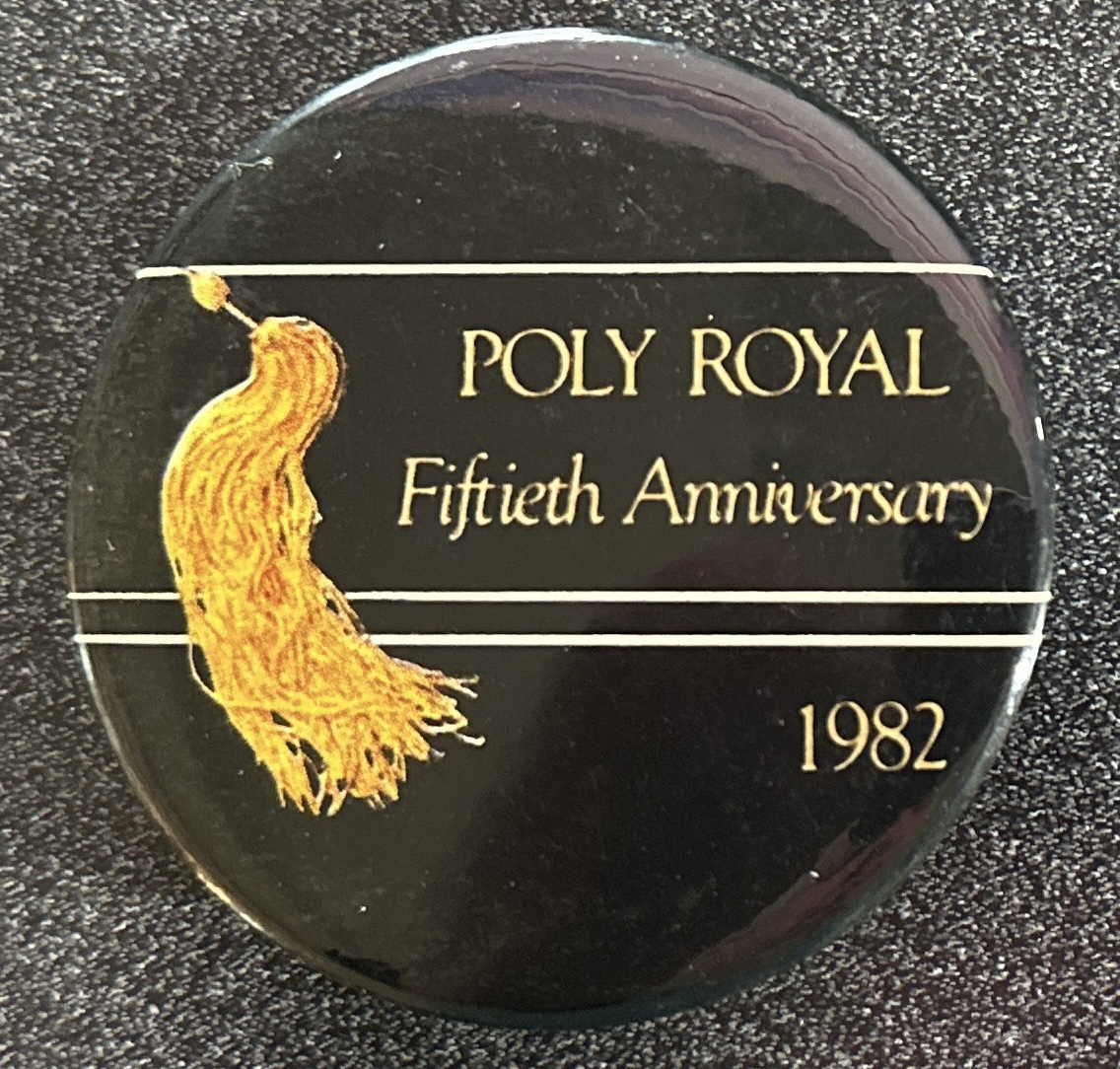
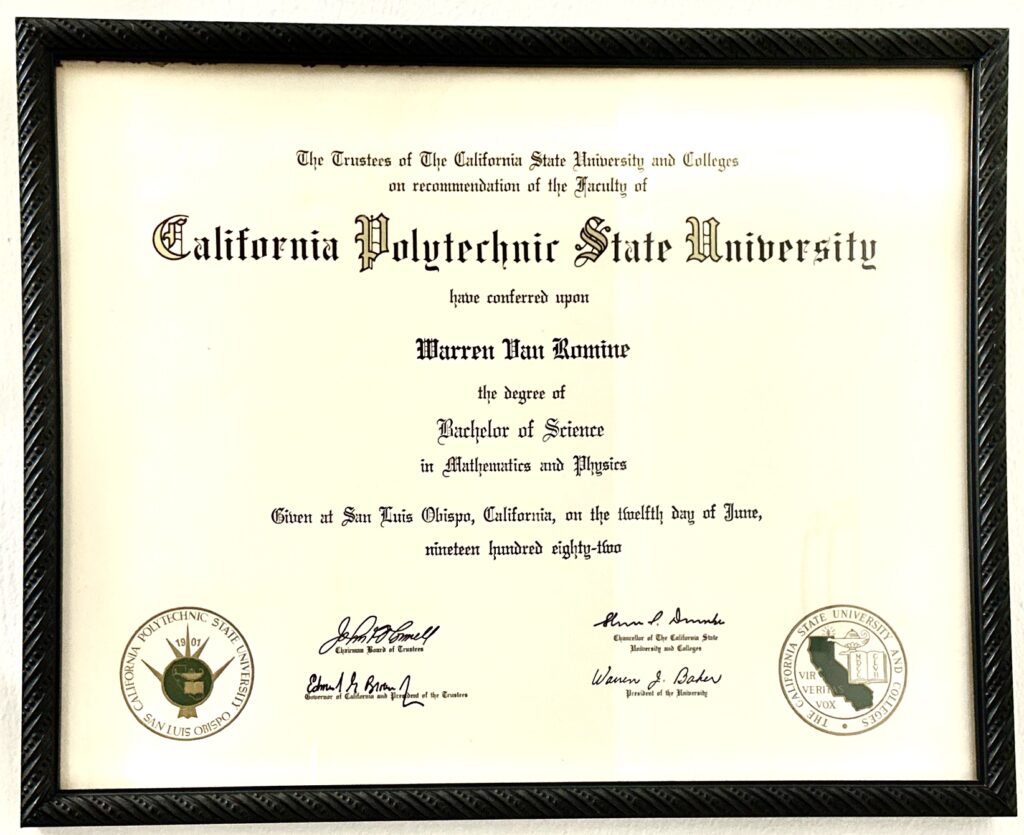
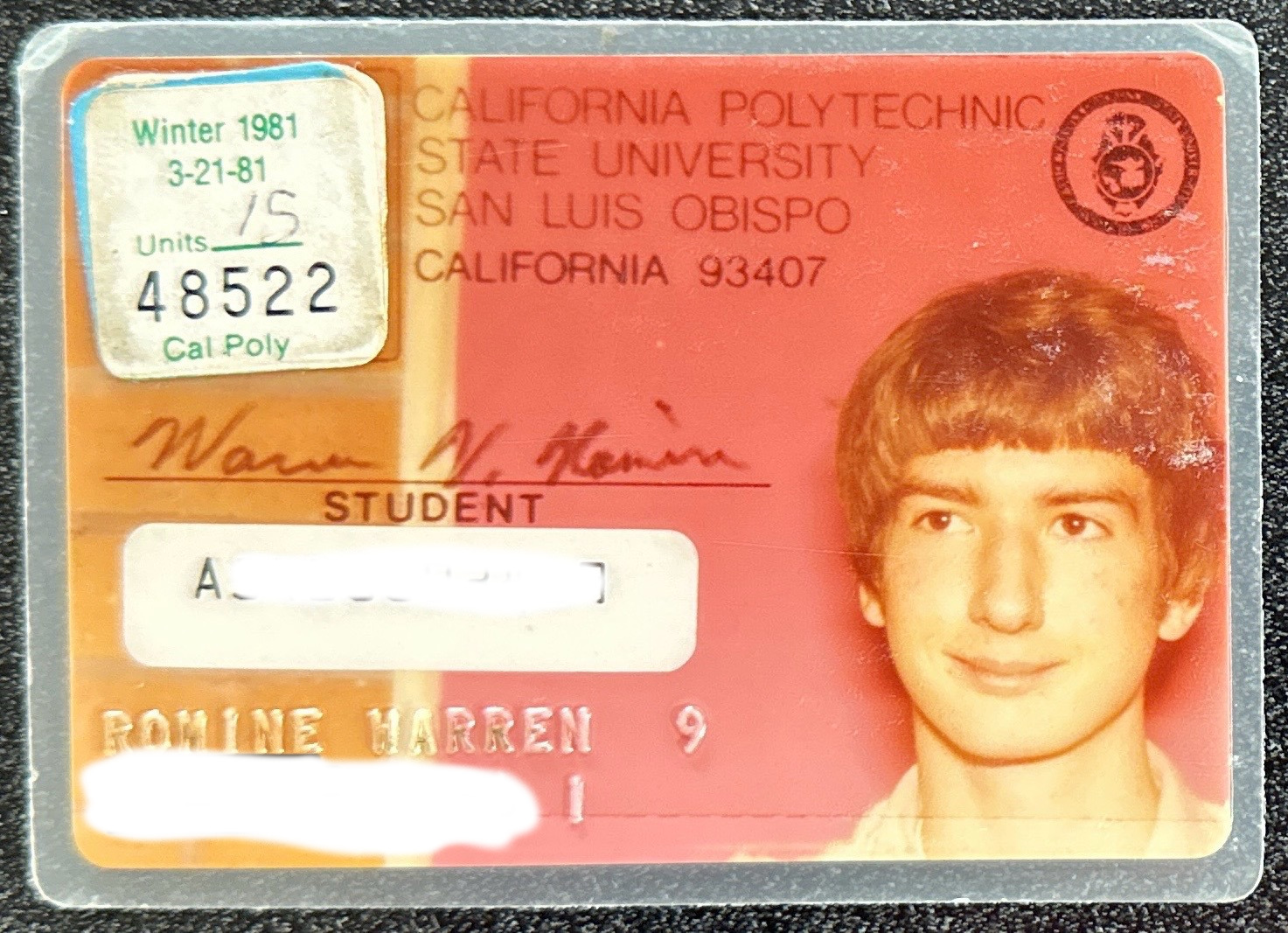
I was 16 when I started… best smile ever!
These are the classes I took. All these years later… I wish I remembered this stuff. Reading through the descriptions, my intellectual passions get excited, and I wish I could take these classes all over again…. but I can’t. I’m too old, … I don’t have enough time/capacity.
Mathematics
- MATH-141: Analytic Calculus — Introduction to analytic geometry and calculus. (College Calculus With Analytic Geometry 3rd Edition, by Murray H. Protter)
- MATH-142: Analytic Calculus — Continuation of MATH 141
- MATH-143: Analytic Calculus — Continuation of MATH 142
- MATH-241: Analytic Calculus — Continuation of MATH 143
- MATH-242: Differential Equations — Ordinary differential equations: introduction with applications in engineering and science; classification of equations and their analytic solutions; study of interrelationships between differential systems; graphs and physical problems.
- MATH-248: Methods of Proof in Mathematics — Methods of proof (direct, contradiction, conditional, contraposition); examples from set theory; quantified statements and their negations; functions, indexed sets, set functions; proofs in analysis; proof by induction; equivalence and well-defined operations and functions; the axiomatic method.
- MATH-304: Vector Analysis — Algebra of free vectors with applications. Differential and integral calculus of vectors. Development of theory and application of vector operations. Green’s Theorem, Stoke’s Theorem, and the Divergence Theorem.
- MATH-312: Linear Algebra — Vector spaces, inner products, linear transformations, linear independence, matrix algebra, linear algebraic systems, determinants, eigenvalues, eigenvectors, applications.
- MATH-318: Advanced Engineering Mathematics — Theory and application of Laplace transforms; Fourier series and transforms; matrices. Advanced Engineering Mathematics by Erwin Kreyszig 3rd Edition.
- MATH-319: Partial Differential Equations — Separation of variables. Orthogonal functions; Bessel functions, Legedre polynomials. Boundary value problems. Applications in vibrating strings and membranes, heat flow, potential theory. Introduction to Ordinary Differential Equations 2nd Edition, by Shepley L. Ross.
- MATH-336: Combinatorial Mathematics — Permutations and combinations; generating functions; recurrence relations; inclusion and exclusion; Ploya’s theory of counting; transport networks; matching theory; block design. (The first time I took this class, I failed it with an ‘F’. I just couldn’t wrap my brain around the concepts. … The second time I took it, I got a ‘D’. I didn’t really earn the ‘D’, but I was so grateful to receive it.)
- MATH-381: Modern Algebra — Fundamental algebraic structures and types of algebras, including operations within them and relations among them. Groups, rings and fields. A First Course in Abstract Algebra by John B Fraleigh. (This class introduced me to the mathematics behind the Rubik’s cube… fascinating!)
- MATH-408: Functions of a Complex Variable — Elementary analytic functions and mappings; Cauchy’s Integral Theorem; power series; theory of residues and evaluation of integrals; harmonic functions.
- MATH-412: Advanced Calculus — Introduction to concepts and methods basic to real analysis. Topics such as real number system, continuity, uniform continuity, differentiation, the integral, uniform convergence, partial differentiation, implicit and inverse function theorems.
- MATH-413: Advanced Calculus — Continuation of MATH 412
- MATH-414: Advanced Calculus — Continuation of MATH 413
- MATH-459: Undergraduate Seminar — Reports and discussions by students, through seminar format, on topics in mathematics education, applied mathematics, or finite mathematics.
- MATH-461: Senior Project — Selection and completion of a project under faculty supervision. Projects typical of problems which graduates must solve in their fields of employment. Project results are presented in a formal report.
- MATH-462: Senior Project — Continuation of MATH 461
Physics
- PHYS-131: General Physics — Fundamental principles of mechanics: vectors, particle kinematics, statics and dynamics, equilibrium of a rigid body, work and energy, linear momentum.
- PHYS-132: General Physics — Rotational kinematics and dynamics, oscillations, waves in elastic media, sound waves, temperature, heat and the first law of thermodynamics, kinetic theory of matter, second law of thermodynamics.
- PHYS-133: General Physics — Charge and matter, electric field, electric potential, dielectrics, capacitance, current and resistance, electromotive force and circuits, magnetic fields, magnetic field of a moving charge, induced emf, geometric and wave properties of light.
- PHYS-134: General Physics — Magnetic properties of matter, Maxwell’s equations, electromagnetic waves, radiation, physical optics.
- PHYS-206: Instrumentation in Experimental Physics — Electrical and electronic circuit elements, operational amplifiers, and digital techniques including logic, counting and analog-digital converters with applications to instrumentation in modern physics.
- PHYS-207: Instrumentation in Experimental Physics — Continuation of PHYS 206
- PHYS-211: Modern Physics — Fundamental principles of modern physics, emphasizing atomic and quantum phenomena. Introduction to special relativity; wave-particle duality; Bohr theory; Schroedinger equation; elementary atomic structure.
- PHYS-213: Introduction to Nuclear Physics — Nuclear radiations and interactions. Detection methods, instruments and radioactive hazards. Nuclear reactions and induced radioactivity. Nuclear energy.
- PHYS-243: Introduction to Nuclear Physics – Laboratory — Techniques of nuclear radiation detection and measurement including Geiger, proportional and scintillation counting. Properties of alpha, beta and gamma radiation.
- PHYS-256: Electrical Measurements Laboratory — Experimental studies of circuit analysis and electronics; introduction to digital techniques; instrumentation.
- PHYS-257: Electrical Measurements Laboratory — Continuation of PHYS 256
- PHYS-301: Heat — Thermodynamics and statistical mechanics. Entropy, temperature, chemical potential, free energy. Selected applications including paramagnetism, ideal gas, Fermi-Dirac distribution.
- PHYS-302: Analytical Mechanics — Vector analysis, statics of particles ad rigid bodies, uniform and parabolic catenary, laws of motion, kinematics and dynamics of a particle. Work and energy. Particle in uniform field. Oscillatory motion (damped and forced oscillation). Center of mass. Linear and angular momentum.
- PHYS-303: Analytical Mechanics — Dynamics of a rigid body, central force motion, accelerated reference frames. Three-dimensional motion of a rigid body, introduction to Lagrange’s and Hamilton’s equations.
- PHYS-317: Special Theory of Relativity — Fundamental experiments and basic postulates of special relativity. Simultaneity, length and time measurements. Lorentz transformations. Four-vectors. Space-time diagrams. Relativistic mechanics and electromagnetism.
- PHYS-323: Physical Optics — Survey of geometrical optics. Interference, Fraunhofer diffraction, Fresnel diffraction, polarization. Selected topics in modern optics.
- PHYS-341: Quantum Physics Laboratory — Experimental studies of particles and radiation, their quantum properties and interactions with atoms and nuclei.
- PHYS-342: Quantum Physics Laboratory — Continuation of PHYS 341
- PHYS-405: Quantum Mechanics — The wave nature of matter. The wave function and its interpretation. The Schroedinger equation. Solutions for one dimensional problems and the one electron atom.
- PHYS-406: Solid State Physics — Crystalline structure of solids. Vibrational and electronic energies in the crystal lattice. Electrical, thermal and magnetic properties of metals, insulators and semi-conductors.
- PHYS-407: Quantum Mechanics — Electron spin and Pauli spin matrices. Matrix mechanics. Total angular momentum. Perturbation theory. Radiative transitions. Identical particles.
- PHYS-408: Electromagnetic Fields — Electric and magnetic field theory using vector analysis. Electric fields, dielectric materials, magnetic fields, induced EMF’s, magnetic materials, Maxwell’s equations, wave equations, plane electromagnetic waves. Dipole radiation, radiation from an accelerated charge.
- PHYS-409: Electromagnetic Fields — Continuation of PHYS 408
- PHYS-456: Solid State Physics Laboratory — Experimental study of the solid state of matter using X-ray, electrical and optical methods.
- PHYS-470: Introduction General Relativity — Directed group study of selected topics for advanced students.
Other
- CHEM-121: Inorganic Chemistry — Fundamental principles including atomic structure, bonding, nomenclature, chemical equations, states of matter, solutions, and energy with attention to applications to related fields.
- CHEM-122: Inorganic Chemistry — Colloids, kinetics, equilibrium, acids and bases, electro-chemistry, nuclear chemistry, non-metals, applications to related fields.
- CHEM-316: Organic Chemistry — Structure, bonding, nomenclature, isomerism, stereo-chemistry and physical properties of organic compounds. Reactions and mechanisms of alkanes, alkenes, alkynes, cycloalkanes.
- CSC-101: FORTRAN Programming — Emphasis on programming techniques for mathematical analysis. Business and science applications (This was my first class, in my first term, in my first year in university, in the spring of 1979. I sat next to a guy named Bill, who asked me, “Do you know who Jesus Christ is?” I sad, “No“. He asked me, “Would you like to?” I said, “Yes“. The rest is history.)
- CSC-221: Computer Principles and Programming — Architecture of System 360/70 computers. Introduction to Basic Assembler Language with emphasis on instructions associated with the general purpose registers. Techniques of programming in an assembly language. “Computers and programming: A system 360-370 assembler language approach Hardcover – January 1, 1974” by Reino Hannula. (I took the class from the author of the book… an amazing man)
- CSC-332: Numerical Nonlinear Analysis — Introduction to the solution of initial value problems for ordinary differential equations. Numerical solution of of nonlinear algebraic equations. Interpolation of data, numerical integration and differentiation of functions. Practical applications and case studies.
- CSC-333: Numerical Solutions of Ordinary Differential Equations — Numerical solution of initial and boundary value problems for ordinary differential equations. Introduction to finite difference methods. Numerical solution of systems of nonlinear algebraic equations. Practical applications and case studies.
- ECON-201: Survey of Economics — Overview of macro-economies: principles and applications in the theory of national income, output and employment. Determination and measurement of the national product; inflation; money; banking; monetary and fiscal policies. Overview of micro-economies: principles and theory of producer and consumer behavior, and the distribution of factor income with a focus on the output market, effect on the national economy.
- ENGL-114: English Composition — Practical study and application of techniques of exposition. Critical reading of model essays. Frequent writing assignments.
- ENGL-115: English Composition — Practical study and application of persuasion and argument. Introduction to library research. Less frequent but more intensive writing assignments culminating in an original research paper. Readings for critical analysis.
- ENGL-340: American Literature to 1860 — Study of selected major prose and poetry of American literature to 1860 (Benjamin Franklin was kinky… read “Advice to a Friend on Choosing a Mistress”, dated June 25, 1745)
- HIST-206: American Democracy and World Affairs — Historic backgrounds of present-day economic, political and social problems. Development of American institutions and ideals. The origin, nature and implementation of U.S. foreign policy since World War Two. Domestic and international factors relating to U.S. objectives; discussion and ana;lysis of major issues and problems of contemporary U.S. foreign policy. (For the first time in my life…. I questioned whether the US government had the moral justification to drop the nuclear bombs on Japan).
- HUM-252: Leonardo Da Vinci — The life and times of Leonardo Da Vinci. (Really enjoyed this class)
- PHIL-223: Critical Thinking — Description not available. (funny huh!)
- PE-250: Health Education — An introductory health course geared to bridge the gap between scientific heath discoveries and one’s application of these discoveries in the daily living pattern. (obviously… I wasn’t paying attention)
- PSCI-201: American Government — The origin, nature and distribution of political power. Declaration of Independence. The Constitution of the United States. Function and current problems of national, state and local government. Finding and evaluating authoritative source materials on political affairs.
- PSY-201: General Psychology — Introduction to psychological research and applications; psycho-biology, perception, learning, motivation, consciousness, cognition, personality and assessment, social behavior, psychopathology and psychotherapy.
- PSY-310: Psychology of Death — On Death and Dying: What the Dying Have to Teach Doctors, Nurses, Clergy and Their Own Families by Elisabeth Kübler-Ross. (I loved this class. It was way out of my normal thinking).
- SP-200: Principles of Speech — Introduction to the fundamentals and principles which underlie effective speech communication. Practical experience in various types of speaking situations: informative, persuasive, and panel discussion. (this class challenged me a lot…. I was soooooo naive!)
- STAT-321: Statistical Analysis — Probability and probability distributions for statistical procedures. Statistical techniques based on sampling from normally distributed populations. Regression and correlation, analysis of variance, analysis of covariance, distribution free procedures. Use of computing facilities in the solution of statistical problems. (I hated this class)
- STAT-322: Statistical Analysis — Continuation of STAT 321 (yeah… and I hated this one too!)
- ZOO-131: General Zoology — Cells, tissues and organ systems of vertebrates; emphasis on man and domestic animals. (loved it!!!!)