The Messier Catalog is perhaps the most famous list of astronomical objects including galaxies, globular clusters and nebulae. It’s a ‘what’s what’ of some of the best objects to see in the night sky with a telescope. The following list of my photographs includes Messier objects plus other Deep Sky Objects (DSO’s).
| Image | Date | Catalog Name | Common Name | Right Ascension | Declination | Observation Time |
|---|---|---|---|---|---|---|
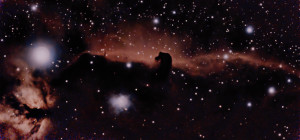 | 2024-12-04 | IC 434 | Horsehead Nebula | 05h 40m 59s | -02° 27′ 30″ | 1 night, 535 x 10sec = 89.2 minutes |
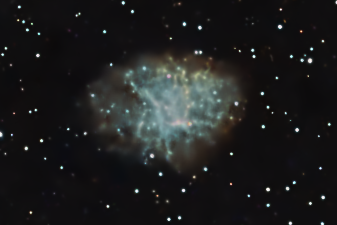 | 2025-01-05 | M1 | Crab Nebula | 05h 34m 32s | +22° 00′ 52″ | 2 nights, 820 x 10sec = 136.67 minutes |
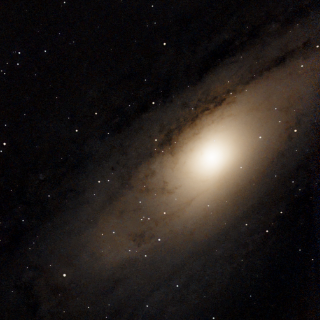 | 2024-10-13 | M31 | Andromeda Galaxy | 00h 42m 44s | +41° 16′ 09″ | 1 night, 593 x 10sec = 98.83 minutes |
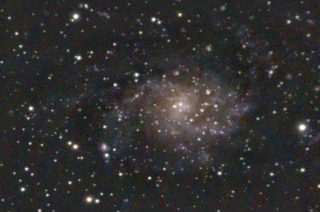 | 2024-10-23 | M33 | Triangulum Galaxy | 01h 33m 50s | +30° 39′ 37″ | 1 night, 124 x 10sec = 20.67 minutes |
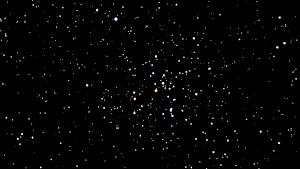 | 2025-01-31 | M41 | Little Beehive Cluster | 06h 45m 50s | -20° 45' 00" | 1 night, 544 x 10sec = 90.67 minutes |
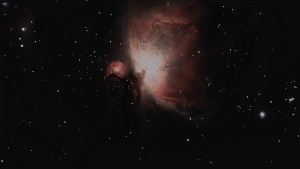 | 2024-12-18 | M42 | Orion Nebula | 05h 35m 17s | −05° 23′ 28″ | 1 night, 466 x 10sec = 77.6 minutes |
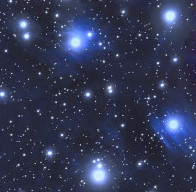 | 2024-12-04 | M45 | Pleiades Star Cluster | 03h 47m 24s | +24° 07′ 00″ | 1 night, 744 x 10sec = 124 minutes |
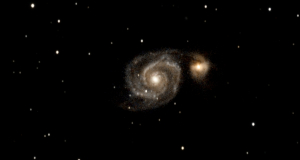 | 2025-05-14 | M51 | Whirlpool Galaxy | 13h 29m 53s | +47° 11′ 43″ | 1 night, 317 x 30sec = 158 minutes |
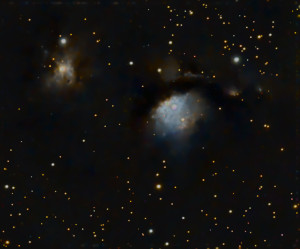 | 2024-12-20 | M78 | Ghost Nebula | 05h 46m 47s | +00° 00′ 50″ | 1 night, 737 x 10sec = 122.83 minutes |
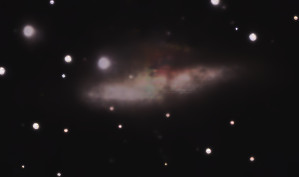 | 2025-02-18 | M82 | Cigar Galaxy | 09h 55m 52s | +69° 40′ 47″ | 1 night, 230 x 10sec = 38.33 minutes |
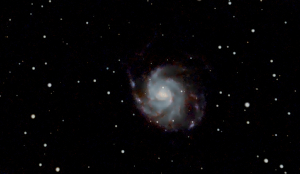 | 2025-02-18 | M101 | Pinwheel Galaxy | 14h 03m 12s | +54° 20′ 57″ | 1 night, 356 x 10sec = 59.33 minutes |
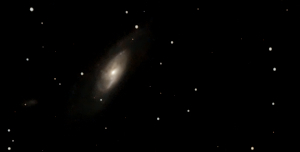 | 2025-02-18 | M106 | Spiral Galaxy | 12h 18m 57s | +47° 18′ 14″ | 1 night, 294 x 10sec = 49 minutes |
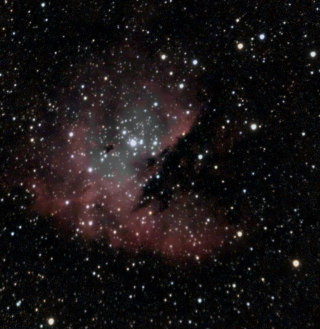 | 2024-10-23 | NGC 281 | Pacman Nebula | 00h 52m 59s | +56° 37′ 19″ | 1 night, 363 x 10sec = 60.5 minutes |
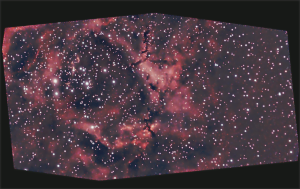 | 2025-01-15 | NGC 2237 | Rosette Nebula | 06h 33m 45s | +04° 59′ 54″ | 1 night, 677 x 10sec = 112.83 minutes |
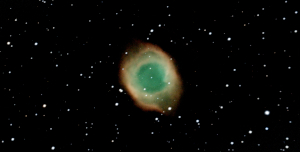 | 2025-10-15 | NGC 7293 | Eye of God | 22h 29m 39s | -20° 50′ 14″ | 1 night, 819 x 10sec = 136 minutes |
Recent Observations
My Process
- Observation Planning: I use two free applications to help me plan the best viewing times/places:
- Astrospheric: This iPhone app forecasts nighttime weather parameters (cloud cover, transparency, and atmospheric turbulence). It has as lot of other useful data as well.
- Light Pollutioin Map: This website gives me guidance on better/worse locations.
- Image Capture: ZWO Seestar S50 with the iPhone app.
- Sensor: The IMX462 OSC has a resolution of 1920 x 1080, a size of 5.6 x 3.2mm, a pixel size of 2.9µm, and a QE of about 90% at 500nm and about 82% at the h-alpha wavelength. Although the read noise is only 1.1e- at unity gain, the small pixels mean it isn’t as low per area as some other chips.
- Optics: Aperture 50 mm, Focal ratio f/5, Focal length 250 mm, Optical lens Apochromatic triplet.
- Image Enhancement: I am learning how to process the raw images from the Seestar, and enhance them. All the software I use is free, which is a nice bonus. Here are the steps I take:
- Transfer the unstacked, subframes (the “fits” files) from the Seestar via USB to my home computer, making sure to put them in a “lights” folder.
- Open Siril, set the proper home directory, then execute: “Scripts > Seestar Pre-Processing” to automatically pre-process the subframes and stack a new image.
- Use Siril to crop the image and then perform “Background Extraction”, “Color Calibration > Photometric Color Calibration, “Remove Green Noise”, “Deconvolution”
- Execute “Star Processing > StarNet Star Removal” to remove all the stars from the stacked image in order to apply a different process between the stars and the rest of the image. I check the “Pre-stretch linear image” option. This step produces both a starmask and a starless fits file.
- Stretch the two images, using histogram transformation, and recombine them into a single file.
- Export the final fits file into a png format, and then run Cosmic Clarity (an AI-based Sharpening and Denoising tool from SetiAstro) to make the last tweaks.
First Observations
When I’m camping (and there is minimal light-pollution and clouds), I’m able to take pictures of the night sky using my iPhone Pro and then upload them to https://nova.astrometry.net/ This website gives me back astrometric calibration meta-data, plus lists of known objects falling inside the field of view. The process (called Astrometric solving or Plate solving or Astrometric calibration of an astronomical image) is a technique used in astronomy and applied to celestial images. Solving an image is finding match between the imaged stars and a star catalogue. The solution is a math model describing the corresponding astronomical position of each image pixel.
In the past, plate solving was done manually by accurately measuring photographic glass plates taken with an astrograph (astrographic camera). Currently, astrometric solving is exclusively done by software programs.
Improving my Observations
Ever since my first picture at Lake Cachuma, I have wanted to improve the quality of my astrophotography (beyond just aiming my iPhone at the sky). So, for my 62nd birthday I purchased a ZWO Seestar S50. It’s a great telescope for me: inexpensive ($500), small/lightweight (5.5lbs), easy to use/setup (controlled by an app on my iPhone), and the raw images can be processed using free software. The next level up in quality equipment is quite a bit more expensive and complicated. So, I figure that this is something I can take camping and really enjoy it more often.
FUN FACT: The United States Naval Observatory Flagstaff Station (NOFS), is the national dark-sky observing facility under the United States Naval Observatory (USNO). I have biked and camped a lot around Flagstaff, so now I have another connection to that area.