The Andromeda Galaxy is a spiral galaxy with a central bar-shaped structure composed of stars and is the nearest major galaxy to the Milky Way. It is approximately 2.5 million light-years from Earth. The mass of the Andromeda Galaxy is of the same order of magnitude as that of the Milky Way, at 1 trillion solar masses. The Andromeda Galaxy has a diameter of about 152,000 light-years. In the upper left corner, I captured M110 which is a dwarf elliptical galaxy that is a satellite of the Andromeda Galaxy.
Milestones
- First time taking an astrophotograph and post-processing it to enhance the raw image.
Viewing Location
This is my first attempt at enhancing the default image from Seestar, and I am pretty happy with the results.
- Lat/Lon: 34.11065, -117.65362
- Sky Magnitude: 18.45 magnitudes/square arcsecond
- Sky Luminance: 4.50 mcd/m2
- Bortle Scale: 7 (suburban/urban transition)…which is pretty awful for star-gazing, but it’s only 20ft from my patio… so it’s convenient. Equal to a Sky Magnitude between 18.94–18.38.
Observation
- Catalog Designation: M31/NGC 224
- Celestial Coordinates: RA 0h 42m 44s | Dec +41° 16′ 9″
- Observation Duration: 1 night, 593 x 10sec = 98.83 minutes
- CCD temperature in degrees Celsius: 24
USE IMAGE SLIDER TO SHOW/HIDE ANNOTATIONS

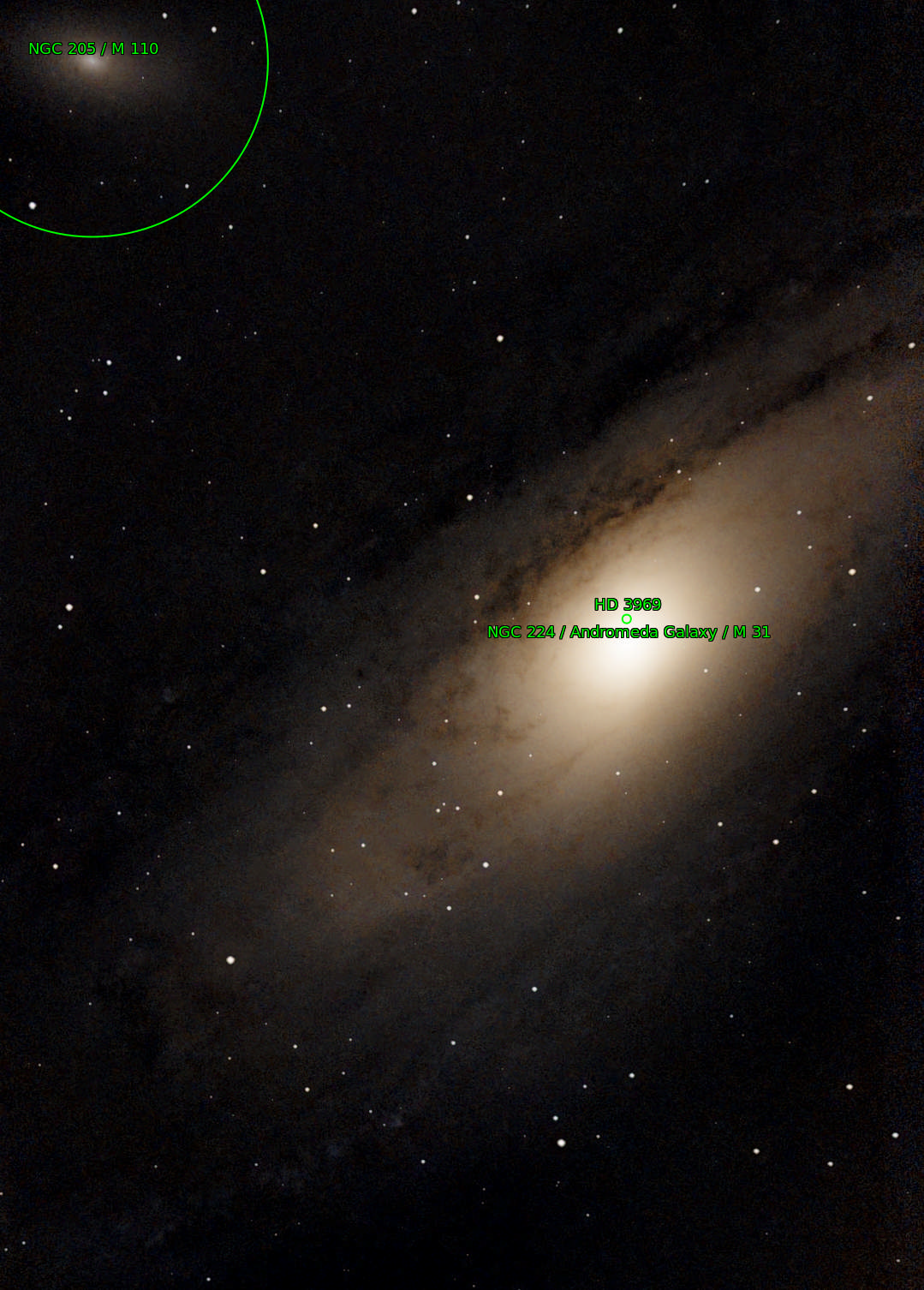
Annotations provided by Astrometry.net through an automated process of “plate solving”.
ZOOM – FULL SCREEN
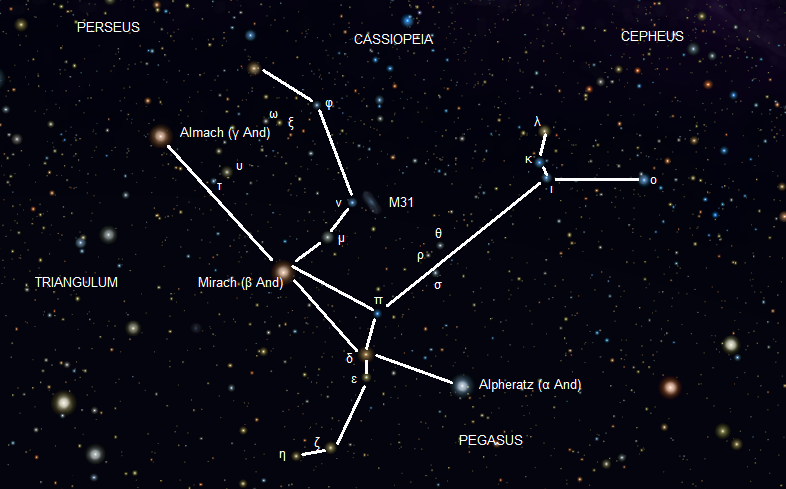
Surrounding Constellation – Andromeda
Here’s a map showing where my photograph of M31 fits in the larger stellar field.