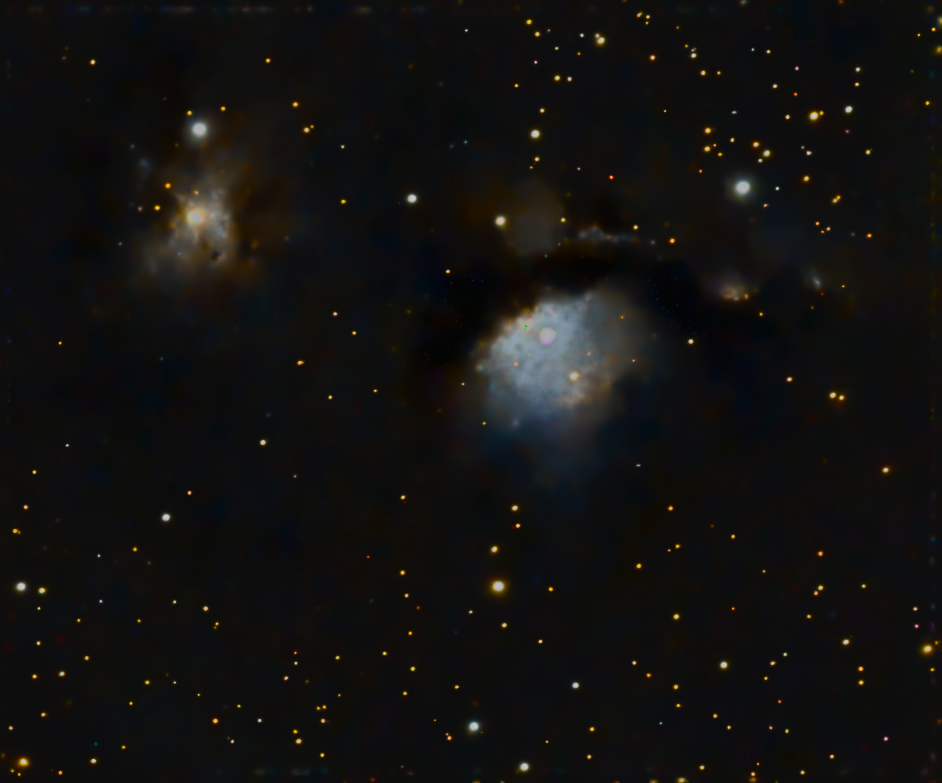
This nebula (Messier 78) is often referred to as the ‘Casper the Friendly Ghost Nebula’, and is labeled as such in the Stellarium planetarium software. M78, also known as NGC 2068, is a reflection nebula located above Orion’s Belt. A reflection nebula is created when light from a star is scattered or reflected off a nearby dust cloud. The ultraviolet radiation from the stars that illuminate it is not intense enough to ionize the gas to make it glow — its dust particles simply reflect the starlight that falls on them.
The pale blue tint seen in the nebula in my picture is an accurate representation of its dominant color. Blue hues are commonly seen in reflection nebulae because of the way the starlight is scattered by the tiny dust particles they contain — the shorter wavelength of blue light is scattered more efficiently than the longer wavelength of red light.
It was discovered by Pierre Méchain in 1780 and included by Charles Messier in his catalog of comet-like objects that same year. HD 38563 A and HD 38563 B are responsible for making the cloud of dust in M78 visible by reflecting their light.
Viewing Location – Valyermo, CA
- Lat/Lon: 34.45669,-117.86837 (SHOW ON MAP)
- Sky Magnitude: 20.94 magnitudes/square arcsecond
- Sky Luminance: 0.453 mcd/m2
- Bortle Scale: 4 (rural/suburban transition) light pollution domes visible in several directions and clouds are illuminated in the directions of the light sources, dark overhead.
Observation
- Catalog Designation: M78/NGC 2068
- Celestial Coordinates: RA 5h 46m 47s | Dec +0° 0′ 50″
- Observation Duration: 1 night, 737 x 10sec = 122.83 minutes
- CCD temperature in degrees Celsius: 23
USE IMAGE SLIDER TO SHOW/HIDE ANNOTATIONS
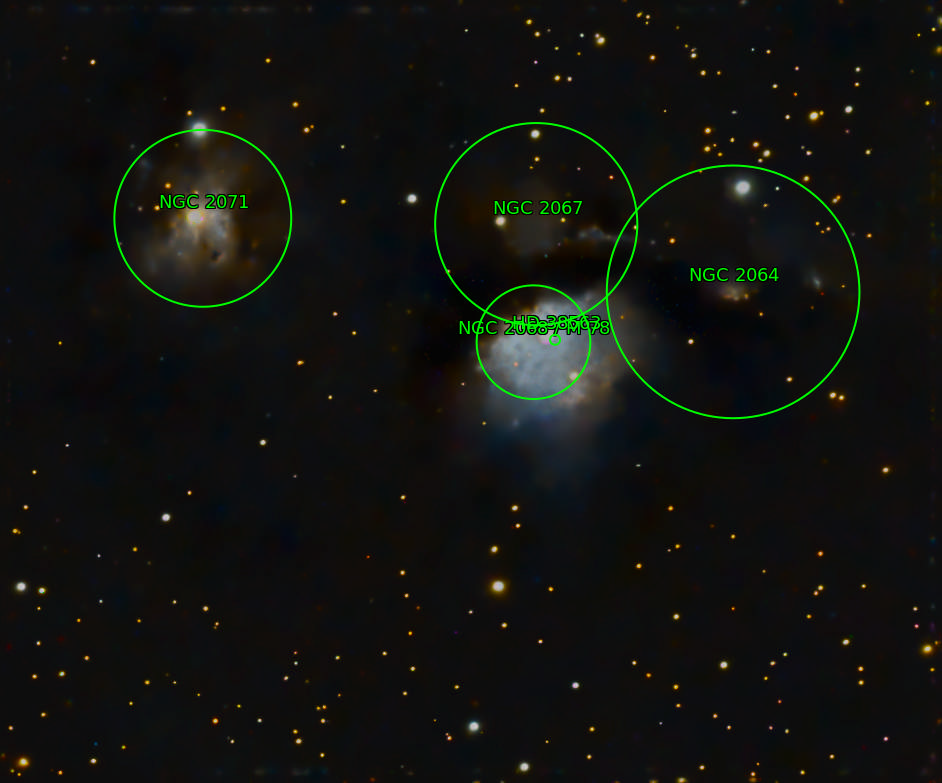
Annotations provided by Astrometry.net through an automated process of “plate solving”.
ZOOM – FULL SCREEN
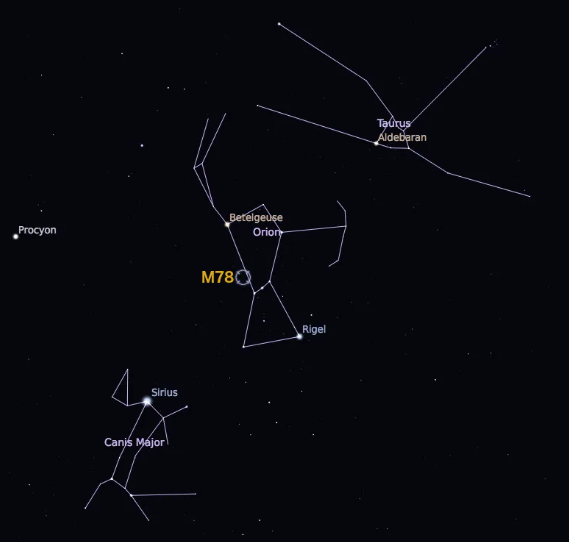
Surrounding Constellation – Orion
Here’s a map showing where my photograph of M78 fits in the larger stellar field.