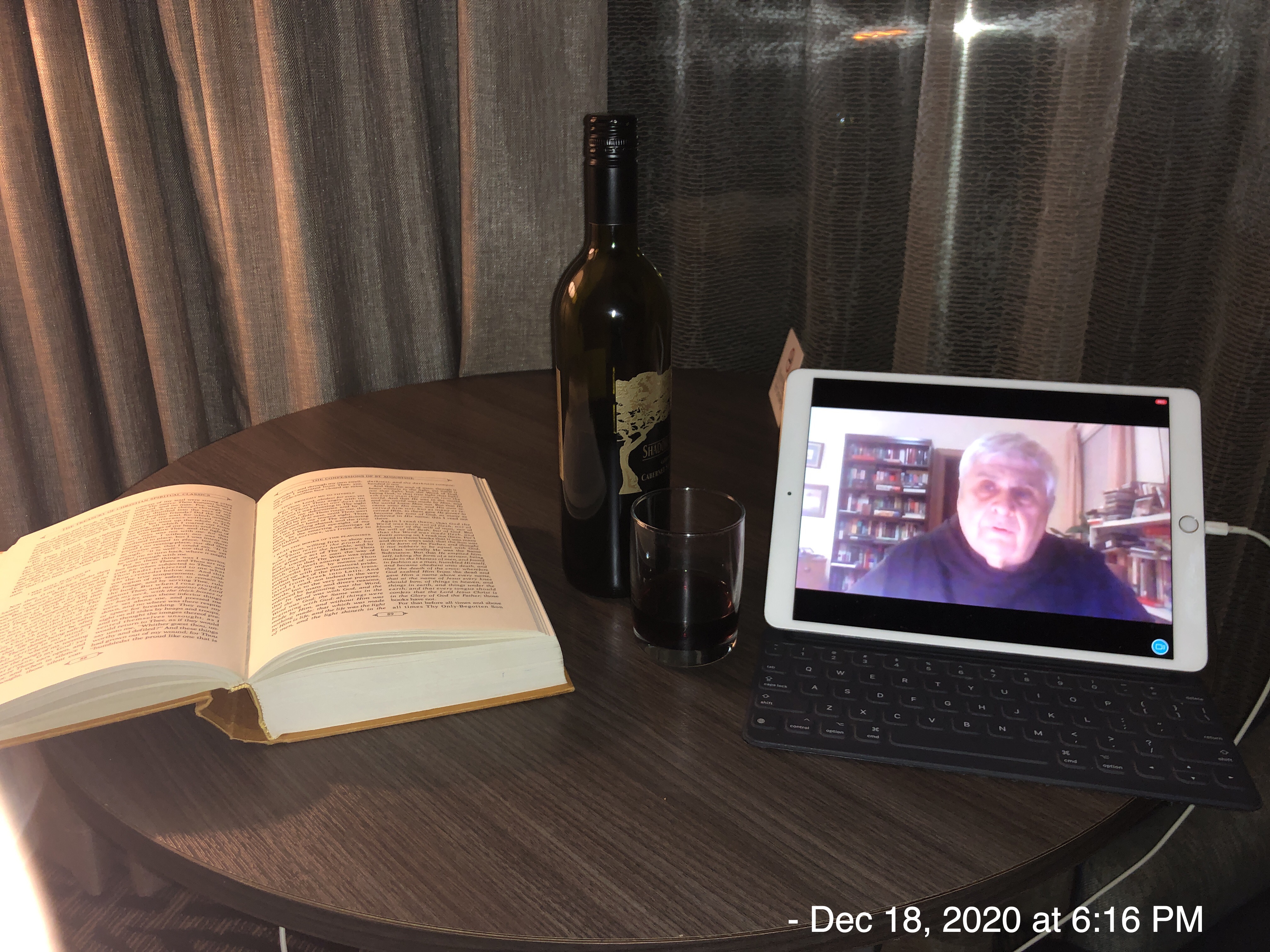
FYI: On August 3, 1995 I bought the book, “The Treasury of Christian Spiritual Classics”. The first entry is “The Confessions of St. Augustine”, of which, I only read a few pages and gave up trying to understand. 25 years later, I used that same book during this retreat. I’m a little slow to pick up on what God is trying to say to me.
Friday, 18 December 2020 3:00 PM –
Sunday, 20 December 2020 10:00 AM
Synopsis: This workshop will explore the major themes covered by St. Augustine in his autobiography, Confessions. This spiritual autobiography focuses on his deep struggle with personal conversion to a life in God. Augustine uses history, memory, reflection, and praise in his search for personal peace and sanctification. All participants are required to read, before the workshop, the first ten books of his Confessions. The Oxford World Classics paperback translation by Henry Chadwick is the preferred version.
Presenter: Fr. Aelred Niespolo, OSB – Fr. Aelred has been a monk of Valyermo since 2001 and was ordained to the priesthood in 2005. Having completed the Master of Theology program at Oxford University, he teaches at St. John’s Seminary in Camarillo. He is editor of the Valyermo Chronicle and has served as Director of Oblates.
- I arrived Friday afternoon at Morro Bay. The pandemic has put huge restrictions on travel, but I managed to evade the police (LOL) drive to the Blue Sail Inn, order take-out from Dorn’s (great restaurant next door), enjoy a glass of red wine in my hotel room and participate in the first session of the Zoom conference. Very relaxing and liberating to be away from home, and in such a pleasant environment.
- During the first evening lecture, Fr. Aelred described how God engaged in a two-part process throughout Augustine’s life: 1) building up a truthful framework for him to understand his spiritual identity and 2) tearing down his previous misunderstandings and self-reliance. Both elevating and humbling him at the same time.
- From an early age, Augustine was taught by his mother to believe in Christ, but he later turned away from it because he thought it was too simplistic and unsophisticated for his lofty professional goals as a thinker. “Augustine started out his adulthood as an intellectual snob”.
- As Augustine matured, he began to explore various non-biblical frameworks and subsequently reject them as being seriously flawed. Eventually, Augustine learned from Ambrose how to see deeper principles and applications of truth in the Bible, by using “typology”. This gave Augustine an almost limitless lens to see what was underneath the stories of the Old Testament.
- Augustine had always depended on the many advantages, privileges and rewards offered to “intellectuals” by Roman society. But as the Roman Empire crumbled during his lifetime, and as Augustine aged, he was forced by circumstances to shift his life’s foundation to a more solid footing. It’s a journey we are all on.
- For myself, God has allowed me to fail morally to the utmost degree, in order to prove to me that it is only His righteousness that I can rely on as the foundation of my existence. I have focused so heavily on my personal journey of sanctification, that I had forgotten why I was created: not to do, but to be. God made me to have fellowship with Him,… nothing is more important.
- Augustine learned that merely wrestling with the antiseptic questions of “good/evil”, “guilt/innocence” is missing a higher truth: intimacy with God. I’m not saying sin is irrelevant. But, I do believe that God has no restrictions on His use of “all things” for our good…. even to the point of using bad things.
- If I am always striving to prove myself worthy to God, I leave no room to enjoy God as my Utmost Eternal Savior. By constantly trying to increase my value to God, I neglect raising the value of God in my own eyes. The result is self-focus, at the expense of a uniquely personal relationship with God.
- By destroying all remnants of spiritual self-confidence, I become liberated to exclusively magnify and worship God. By getting off the endless treadmill of earning something with God, I can devote all my energies to appreciating the fullness of God.
- The third lecture opens with “We develop repentance … it is a process, not a single event. Just like how sanctification is not a moment in time, repentance evolves over our entire lives.” … I have never understood this.
- Soren Kierkegaard was much like Augustine. God engages with us in our own lives, who we experience for ourselves.
- The “Confessions of St. Augustine” help me to practice the following principle: I believe so I may understand better. I understand so I may believe deeper.
- Repentance is “transcending yourself”. I have always defined repentance as a reshaping or remolding of myself into a better version. The truth is, “self-derived repentance” is temporary but “God-derived repentance is eternal. Therefore, to truly repent, I have to transcend self. This also means that repentance is a gift from God, not a gift I give to myself.
- Understanding God requires an understanding of myself too. This is the biggest thing I learned from St. Augustine.
- The last day, I have come to realize that God has been at work all my life to teach me about myself… as well as about Himself. I assumed that learning about myself was a waste of valuable time that could be better spent learning about God. Instead, God has helped me to understand Him better, by explaining my true self to ME. Truth is always valuable and precious. Truth, wisdom, awareness, clarity and understanding about myself are valid entry-points for God to reach me.
- God’s Word explains so much about truth. But, I can’t put the Word into my life unless I know how I fit/don’t fit with the Word. This means I can misapply the Word to myself, just by simply misunderstanding myself. God must not only give me the medicine, but He must also tell me how to utilize that medicine to cure me. There is a protocol that must be followed in order to be healed, and that comes in addition to the medicine.
- God has spent a lot of time teaching me the truth about myself. Augustine says there is a great abyss of mystery inside myself. Only God knows me fully, and only God can explain me.
- I am not afraid, nor am I ashamed to spend time with God in the pursuit of knowing myself better. If God leads me to explore my interior soul, then how can I refuse Him?
- The goal is not selfish introspection, but divine illumination of who God made me to be. I engage with God as He shines His light onto the deep abyss of my soul. In this journey with Him, I discover more about us both, and I am always drawn closer to Him than before.