Friday, 29 December 2023 5:00 PM –
Sunday, 1 January 2024 10:00 AM
Synopsis: In the early sixth century the monk we have come to know as “Benedict” wrote a rule for monasteries that has been in continuous use for more than fifteen hundred years. Part of the reason for the success of the Benedictine Rule is its author’s willingness to gently adapt and improve existing ascetical and spiritual practices in accordance with the needs of his age. In this workshop, we will study selected portions of Benedict’s Rule to discover how his wise approach to work and prayer may be lived out in our own day, and we will also study select texts by his later biographers and disciples to see how his wisdom was developed and applied in the centuries after his death.
Presenter: Father Luke Dysinger – Fr. Luke has been a monk of Valyermo since 1976. He is a priest and a physician who writes and teaches in the fields of mystical theology and biomedical ethics. He earned a Ph.D. at Oxford University and currently teaches at St. John’s Seminary in Camarillo, CA as well as online courses.
DAY 1:
http://ldysinger.com/retreats/benedict_and_disciples_spirituality
- It’s almost time for Vespers. It’s taken me a couple of hours to relax and stop thinking about the outside world. This is a place of solitude. I need to let that peacefulness take over.
- During Vespers, I sat in the center aisle, on the back row. My previous experience was that the monks entered the chapel from the front through side doors. This time they came from the back, two columns, right down the center…. Weaving their way around me, who was blocking their path to holiness. And, of course they had to walk back the same route on their way out. 15 minutes later, they were serving me dinner. The life of a monk isn’t easy, when I’m around.
- Dinner was great, spaghetti and meatballs. I have to say, the monks eat well.
- We had our first retreat session. Fr. Luke Dysinger was as good as ever. He draws me into such a peaceful and deep spiritual place.
- The Benedictine Order emphasizes two points: 1) “listening” and 2) steps towards deification. I thought about how this is different than sanctification. I’m not sure, but I think Fr. Luke might say that sanctification is a process that transforms us into people who do not sin… removing bad behavior. Whereas, deification transforms us into god-like people… having Christ’s character.
- I showed up 15 minutes early for Compline, so I could pick the spot I wanted. The chapel was empty. I sat on the far right side, up against the wall. The monks walked in at the front, from the side doors. We all agreed to stay out of each other’s way… 😇
- During Compline, I just absorbed the atmosphere. There was the smell of incense. I felt the hard edges of my soul, start to round-over. My heart softened, and my spirit relaxed. I felt spiritually “at home”.
- Church doesn’t feed my soul like this retreat does. Nothing comes close to this.
- At the end of Compline, the Abbot sprinkled holy water on us…. Even me. It was my first time.
- I’m going to bed, just a little holier than I woke up.
DAY 2:
- I asked Fr. Luke about the difference between sanctification and deification, and he confirmed my understanding. I mentioned the idea that Christ’s sacrifice doesn’t restore us to a place equal to Adam’s condition before the Fall, but to an existence far above that. He wholeheartedly agreed.
- 1 John 3:2 (TPT) “Beloved, we are God’s children right now; however, it is not yet apparent what we will become. But we do know that when it is finally made visible, we will be just like him, for we will see him as he truly is.”
- There comes to my mind two scenarios:
- The world blows a hot, sinful wind against us, and we are told to resist it, holding firm to our faith
- The Spirit invites us to float on the river of His grace, and flow downstream towards godliness.
- The first involves striving and the second involves surrendering. Just a thought.
- Fr. Luke mentioned that the goal of the Benedictine Rule is to help you become the person that God wants you to be. This seems monumentally important. I feel God has reinvented me these last few years (retreats, biking, and now camping). I never could have believed that God would build these pillars of happiness and fulfillment in my life. But, now I can see that this is God’s transformation of my life into the image He always wanted for me. How beautiful is that?
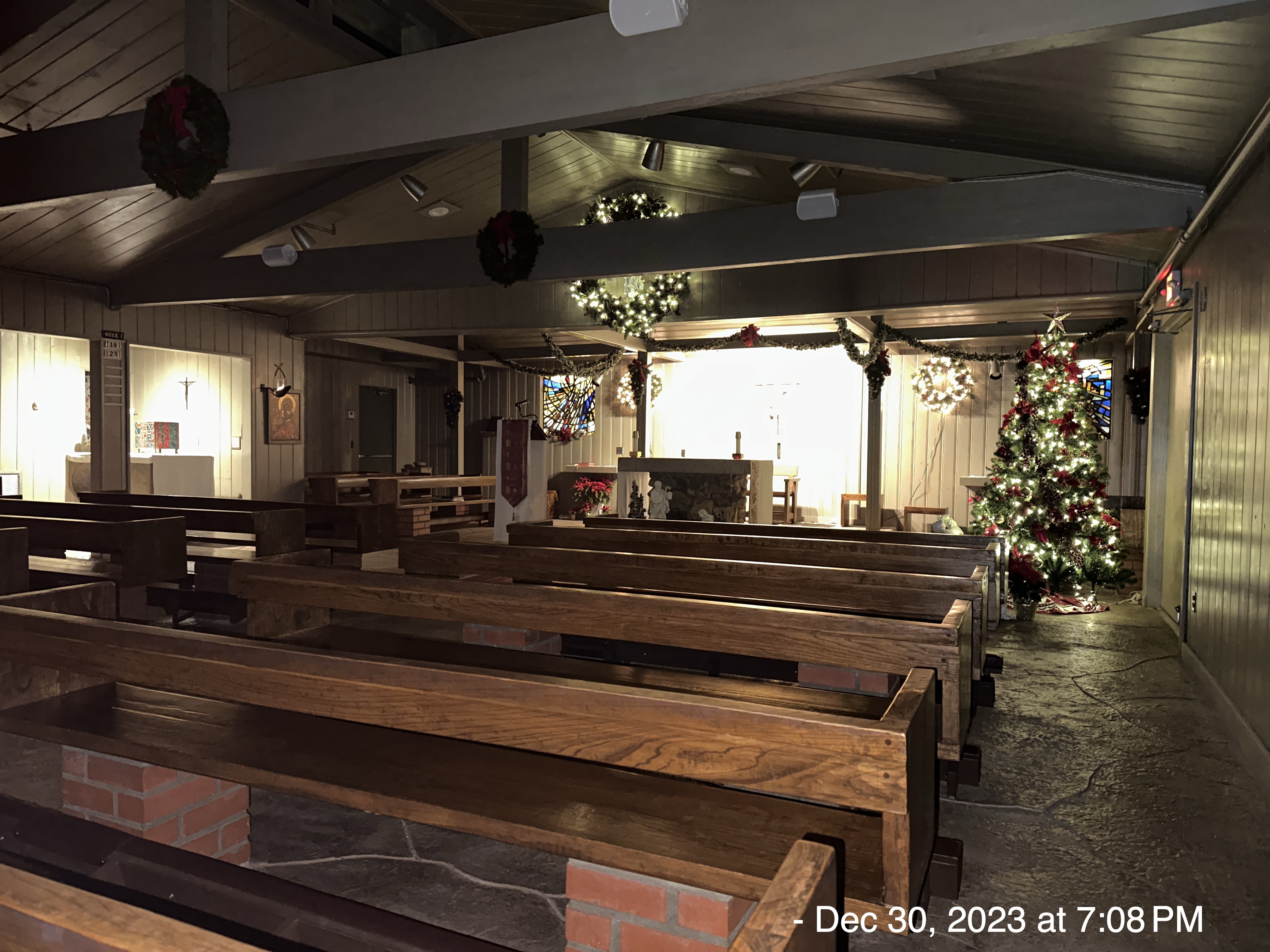
- At Vigils this evening, Fr. Patrick mentioned God’s “deep plan” for our lives. I feel that the last 5 years has been a significant unfolding of that plan for me.
- One of the key concepts of my interior life is a focus on Being vs. Doing. I want to BE the person God envisions. I don’t want to “do things” to achieve that, I want “live” my way into it.
- Vice is anything that separates us from God, and so the opposite is anything that draws us close to God
It was a cold (42F) clear night on Saturday, I couldn’t resist taking a picture.

CLICK HERE FOR THE CONSTELLATIONS I HAVE SEEN
DAY 3:
- The Rule of Benedict – Chapter 7: Humility
- Therefore, brothers, if we wish to arrive at the highest point of humility, and speedily reach that heavenly exaltation to which we can only ascend by the humility of this present life,
- we must by our ever-ascending actions erect a ladder like the one Jacob beheld in his dream, by which the angels appeared to him descending and ascending (Gen. 28:12).
- Without doubt this descent and ascent can signify nothing else than that we descend by exaltation and ascend by humility.
- And the ladder thus erected is our life in the world, which, if the heart is humbled, is lifted up by the Lord to heaven.
- The sides of the same ladder we assert to be our body and soul, in which the call of God has placed various steps of humility or discipline, which we must ascend.
- St. John Climacus, THE LADDER OF DIVINE ASCENT. The Ladder describes how to raise one’s soul and body to God through the acquisition of virtues. Climacus uses the analogy of Jacob’s Ladder as the framework for his spiritual teaching. Each chapter is referred to as a “step”, and deals with a separate spiritual subject. The final step is “Concerning the linking together of the supreme trinity among the virtues”:
- And now, finally, after all that we have said, there remain these three that bind and secure the union of all, faith, hope, love; and the greatest of these is love, for God Himself is so called.
- And (as far as I can make out) I see the one as a ray, the second as a light, the third as a circle; and in all, one radiance and one splendour.
- The first can make and create all things; the divine mercy surrounds the second and makes it immune to disappointment; the third does not fall, does not stop in its course and allows no respite to him who is wounded by its blessed rapture.
- Pope Benedict XVI, 2009 on John Climacus: “The Ladder”
- … the monastic life is only a great symbol of baptismal life, of Christian life. It shows, so to speak, in capital letters what we write day after day in small letters. It is a prophetic symbol that reveals what the life of the baptized person is, in communion with Christ, with his death and Resurrection. The fact that the top of the “ladder”, the final steps, are at the same time the fundamental, initial and most simple virtues is particularly important to me: faith, hope and charity. These are not virtues accessible only to moral heroes; rather they are gifts of God to all the baptized: in them our life develops too. The beginning is also the end, the starting point is also the point of arrival: the whole journey towards an ever more radical realization of faith, hope and charity. The whole ascent is present in these virtues.