The Rosette Nebula (New General Catalogue: NGC 2237) is an emission nebula in the Monoceros (Unicorn) constellation. NGC 2237 is a cloud of gas that glows due to radiation from nearby stars situated close to the celestial equator and, as such, it is at least partly visible from both hemispheres in certain times of the year.
The nebula glows in the red part of the spectrum because the powerful ultraviolet radiation from the stars strips electrons from the nebula’s hydrogen atoms. The dark filaments of dust extending toward the center of the nebula, sometimes called “elephant trunks,” are shaped by the stellar winds and radiation from hot young stars and electromagnetic forces.
This combination of a star cluster and nebula has five separate entries in the New General Catalogue: NGC 2237, NGC 2238, NGC 2239, NGC 2244, and NGC 2246. And although they all lie within the constellation Monoceros the Unicorn some 5,200 light-years away, they weren’t all discovered at the same time. The beautiful open cluster NGC 2244, which lies at the center of the nebulous complex, was found by English astronomer John Flamsteed in 1690. Then, in 1830, John Herschel discovered the first nebulous region, NGC 2239. Next up was NGC 2238, discovered in 1864 by German astronomer Albert Marth. To complete the picture, American astronomer Lewis Swift discovered NGC 2237 in 1871 and NGC 2246 in 1885.
Viewing Location – 1 night in Upland, CA
- Lat/Lon: 34.11065, -117.65362
- Sky Magnitude: 18.45 magnitudes/square arcsecond
- Sky Luminance: 4.50 mcd/m2
- Bortle Scale: 7 (suburban/urban transition) equal to a Sky Magnitude between 18.94–18.38.
Observation
- Catalog Designation: NGC 2237/Caldwell 49
- Celestial Coordinates: RA 06h 33m 45s | Dec +04° 59′ 54″
- Observation Duration: 1 night, 677 x 10sec = 112.83 minutes
- CCD temperature in degrees Celsius: 22
USE IMAGE SLIDER TO SHOW/HIDE ANNOTATIONS
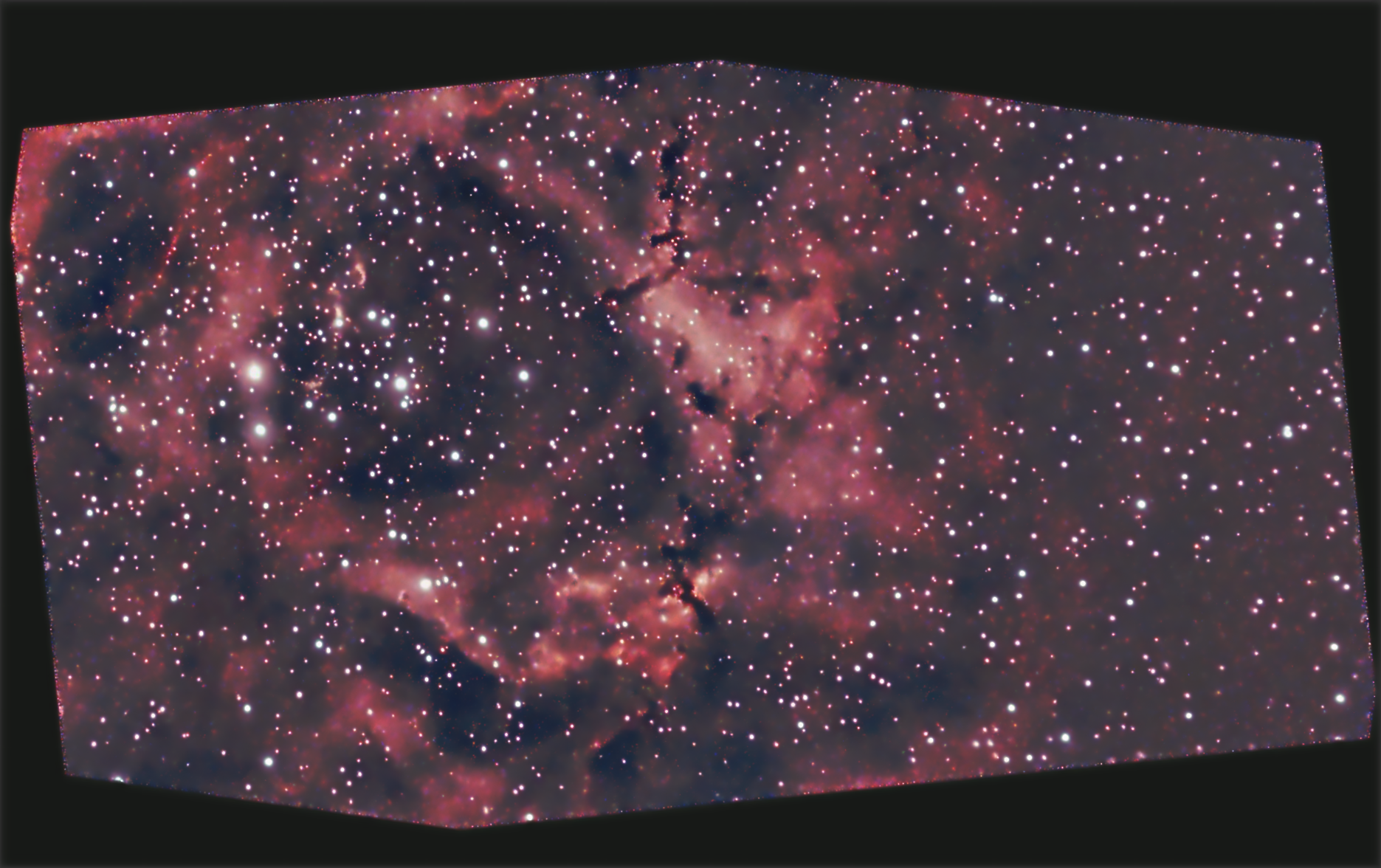
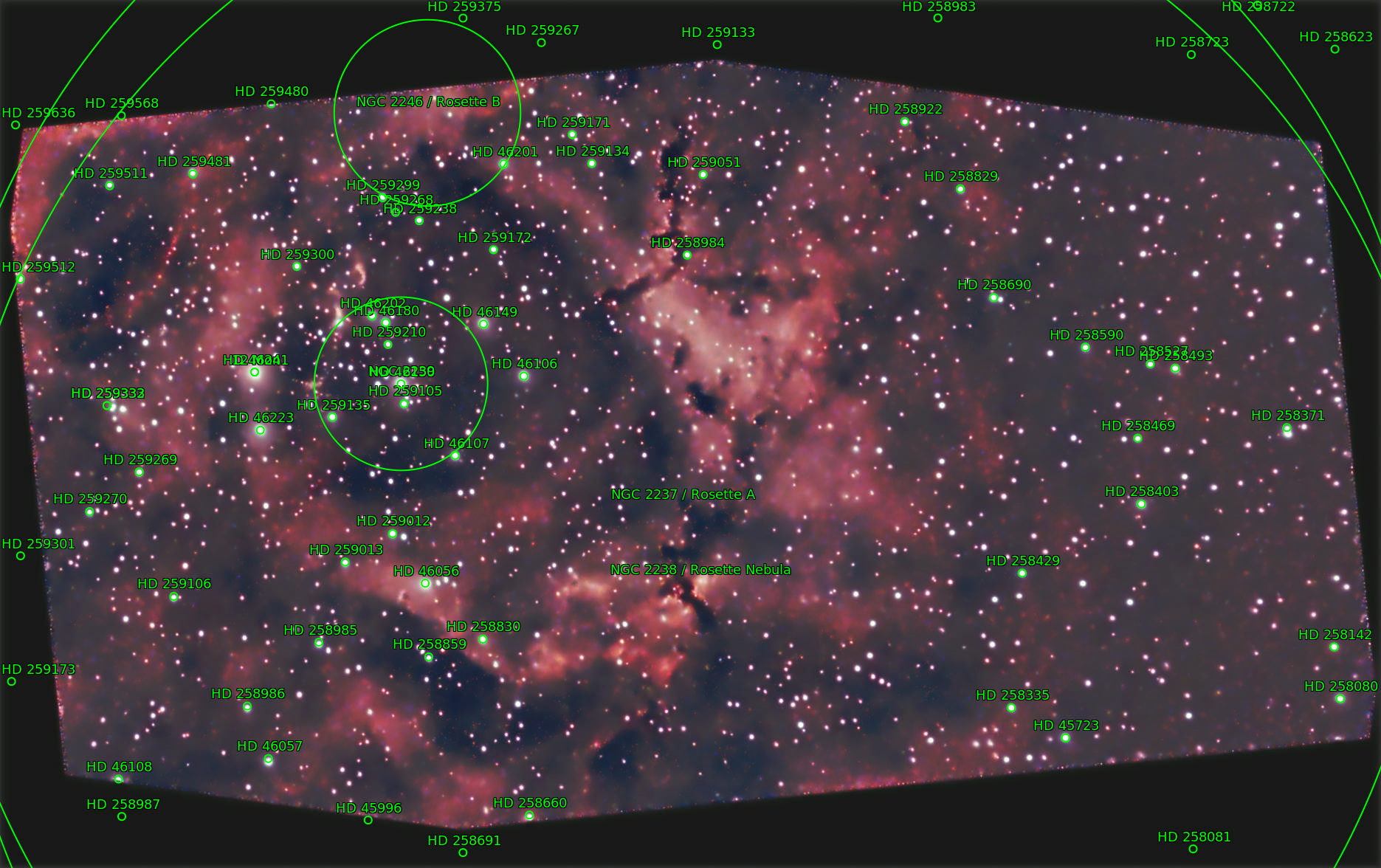
Annotations provided by Astrometry.net through an automated process of “plate solving”.
ZOOM – FULL SCREEN
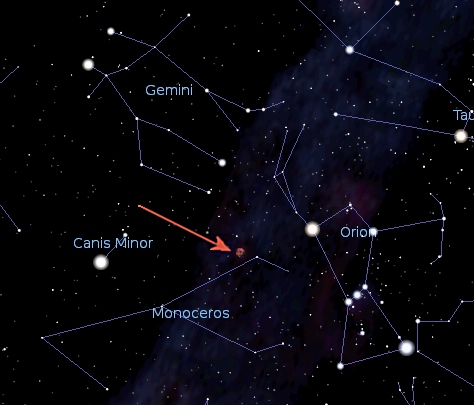
Surrounding Constellation – Monoceros
NGC 2237 can best be seen in the Northern Hemisphere in the winter months, located between stars Betelgeuse in the constellation Orion and Procyon in Canis Minor.
The Rosette Nebula spans 130 light years and is much larger than the better-known Orion Nebula, which is about 24 light years across. However, the Orion Nebula is much closer to us at 1,344 light years and appears brighter but smaller than the Rosette.