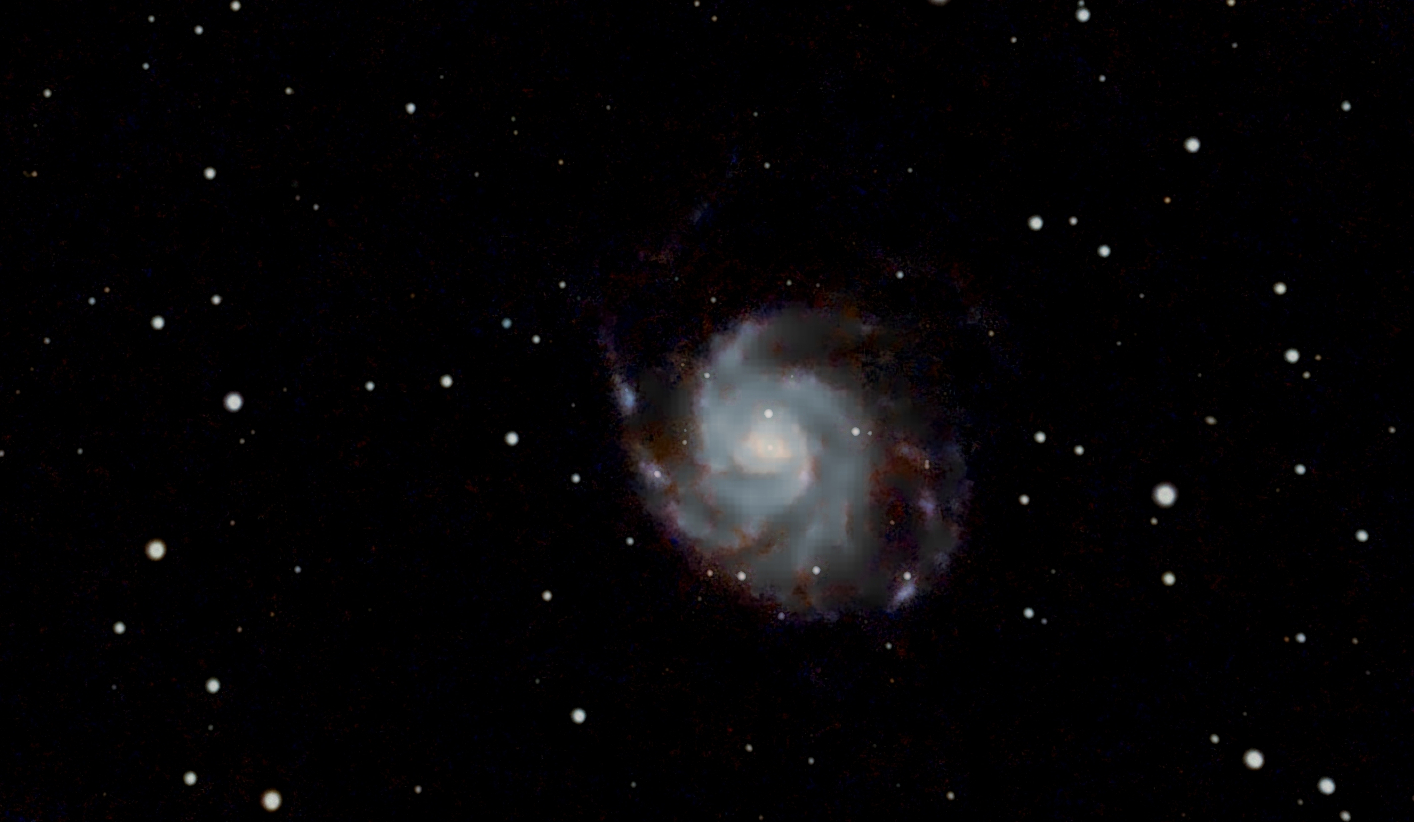
The Pinwheel Galaxy is a large galaxy, with around a trillion stars. It was discovered by Pierre Méchain in 1781. M101 is asymmetrical due to the tidal forces from interactions with its companion galaxies. These gravitational interactions compress interstellar hydrogen gas, which then triggers strong star formation activity in M101’s spiral arms.
There are 3 different types of galaxies, elliptical, spiral, and irregular. M101 is a grand design spiral galaxy. A grand design spiral galaxy is one that has a clearly defined and well organised spiral structure. This is in contrast to galaxies in which the spiral arms are less well defined, often called flocculent spirals.
Viewing Location – Near the Salton Sea, Imperial County, CA
- Lat/Lon: 33.3815562,-115.6448477
- Sky Magnitude: 21.65 magnitudes/square arcsecond
- Sky Luminance: 0.237 mcd/m2
- Bortle Scale: 4 (rural/suburban transition) equal to a Sky Magnitude between 21.69–20.49.
Observation
- Catalog Designation: Messier 101, NGC 5457
- Celestial Coordinates: RA 14h 03m 12.6s | Dec +54° 20′ 57″
- Observation Duration: 1 night, 356 x 10sec = 59.33 minutes
- CCD temperature in degrees Celsius: 25
USE IMAGE SLIDER TO SHOW/HIDE ANNOTATIONS
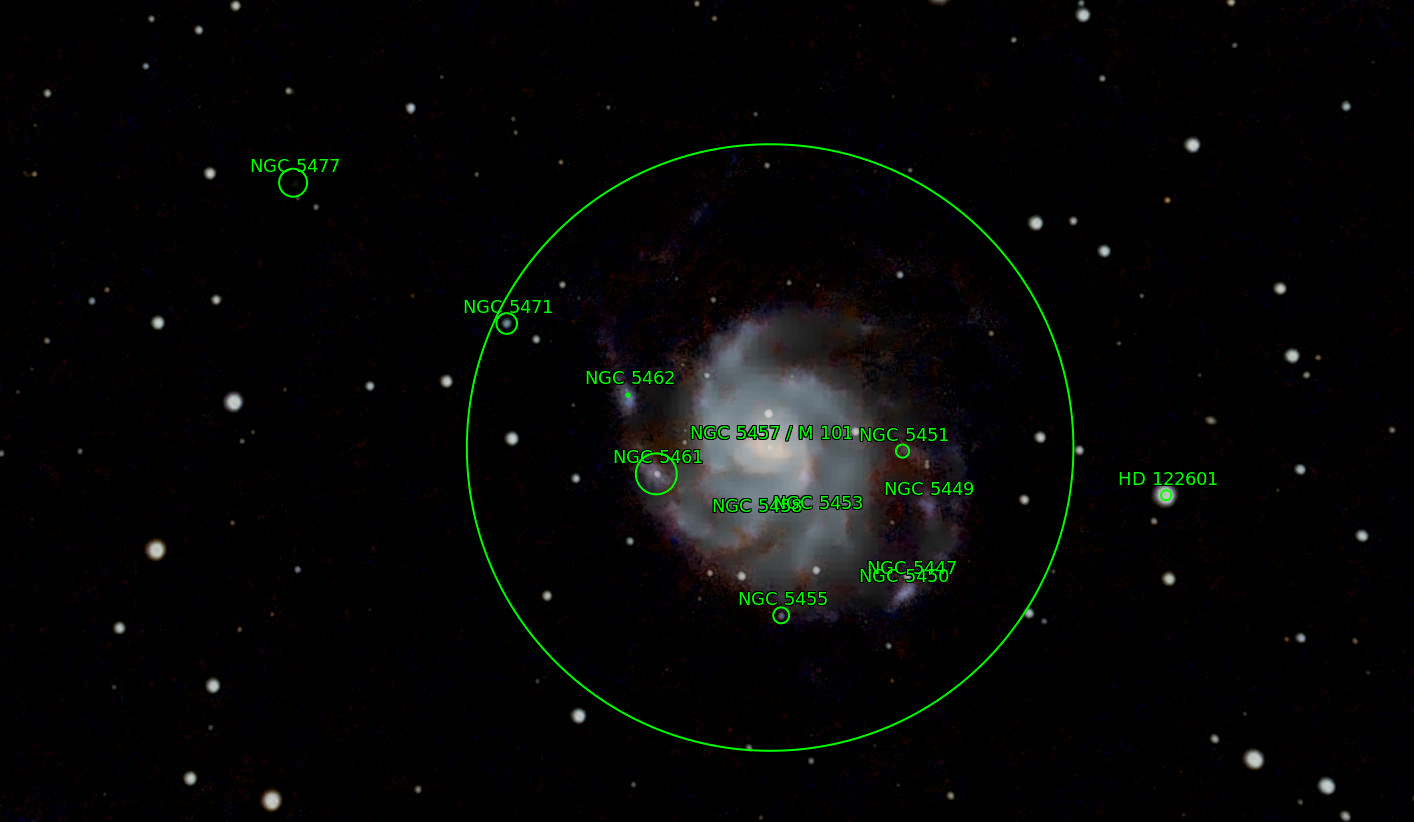
Annotations provided by Astrometry.net through an automated process of “plate solving”.
ZOOM – FULL SCREEN
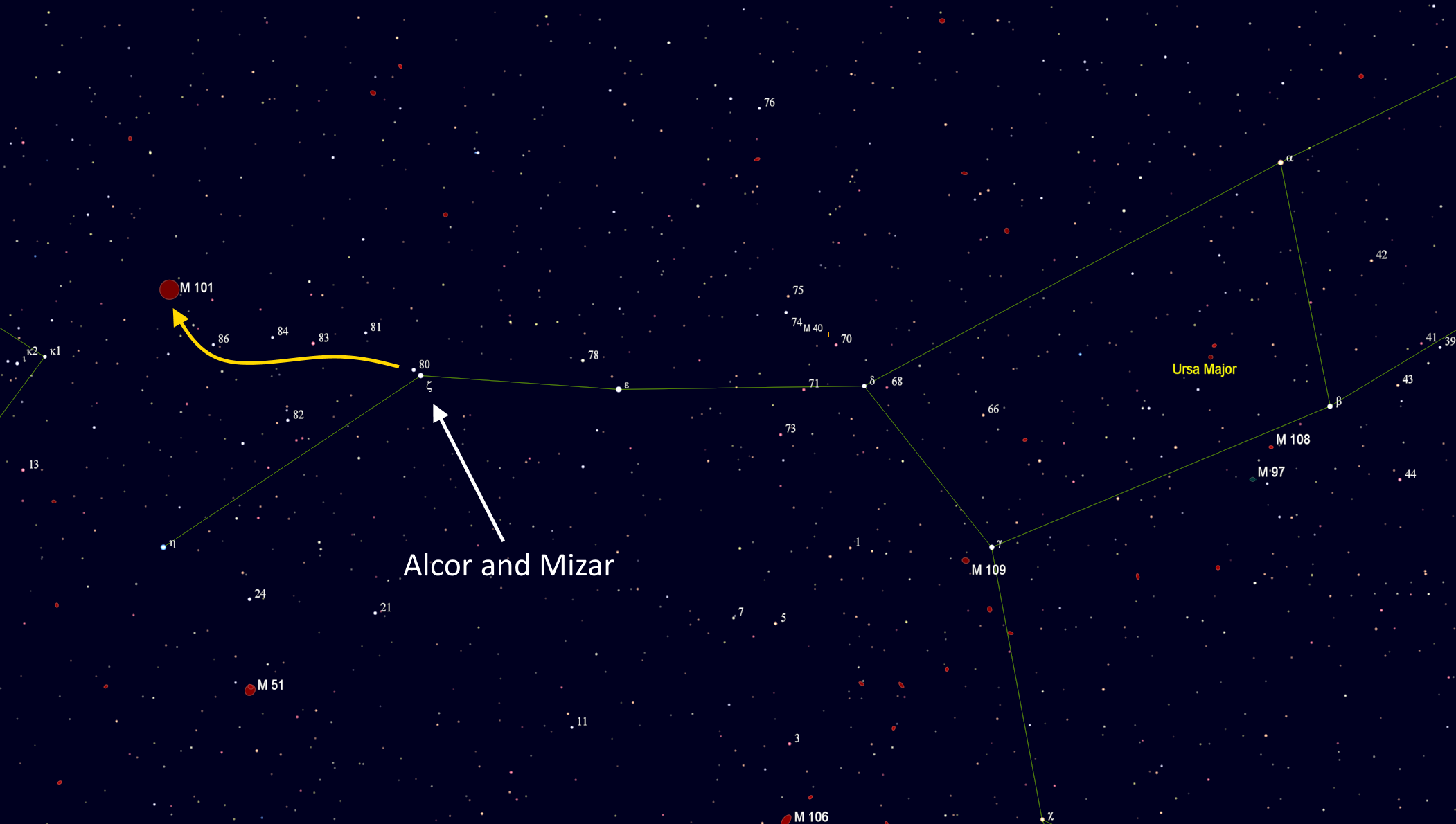
Surrounding Constellation – Ursa Major
Several bright galaxies are found in Ursa Major, including the pair Messier 81 (one of the brightest galaxies in the sky) and Messier 82 above the bear’s head, and Pinwheel Galaxy (M101), a spiral northeast of Alkaid, the star at the end of the tail.