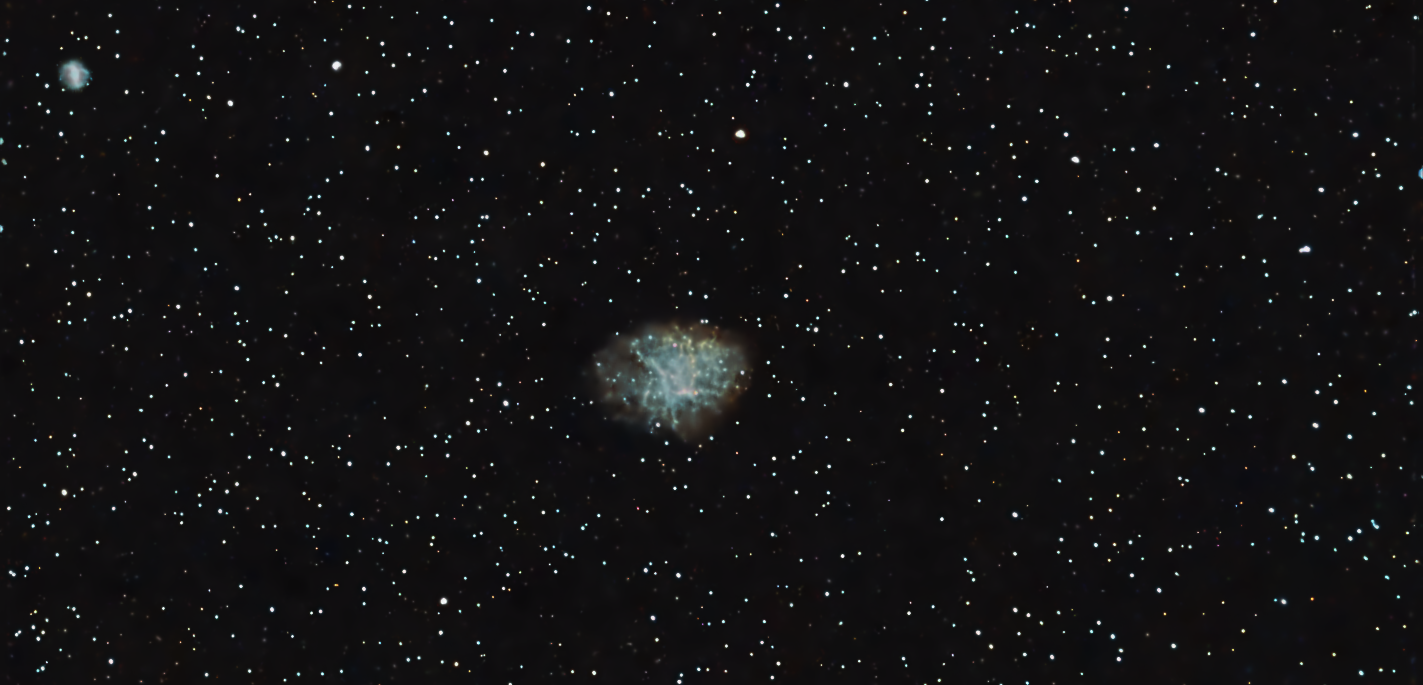
This nebula (Messier 1) is a supernova remnant and pulsar wind nebula in the constellation of Taurus. It left behind a rapidly spinning Neutron Star (Pulsar) and is now one of the strongest sources of gamma rays and X-rays in the sky. Its X-ray emissions are so strong that they were actually used to measure the thickness of the atmosphere on Saturn’s moon Titan, as the nebula passed behind the moon from our field of view.
It was discovered by English astronomer John Bevis in 1731. Charles Messier originally mistook M1 for Halley’s Comet, which inspired him to create his famous catalog of objects. It corresponds with a bright supernova observed in 1054 C.E. by Native American, Chinese, Japanese, and Arabic stargazers. It was the first astronomical object identified that corresponds with a historically-observed supernova explosion.
The common name comes from a drawing that somewhat resembled a crab with arms produced by William Parsons, 3rd Earl of Rosse, in 1842 or 1843 using a 36-inch telescope. Rosse’s drawing has been much criticized for its lack of resemblance to the true nebula. Rosse himself recognized this when he reobserved M1 with the improved power of the 72-inch in 1848. Specifically calling it the “Crab nebula” (in quotation marks), he ruefully noted: ‘Would have figured it different from the (earlier) drawing.’
Viewing Location – 2 nights at separate sites in Upland, CA
- Lat/Lon: Night #1 = 34.11065, -117.65362, Night #2 = 34.12988,-117.65849
- Sky Magnitude: 18.45 magnitudes/square arcsecond
- Sky Luminance: 4.50 mcd/m2
- Bortle Scale: 7 (suburban/urban transition) equal to a Sky Magnitude between 18.94–18.38.
Observation
The Crab Nebula is best observed in January.
- Catalog Designation: M1/NGC 1952
- Celestial Coordinates: RA 5h 34m 31.97s | Dec +22° 00′ 52.1″
- Observation Duration: 2 nights, 820 x 10sec = 136.67 minutes
- CCD temperature in degrees Celsius: 23
USE IMAGE SLIDER TO SHOW/HIDE ANNOTATIONS
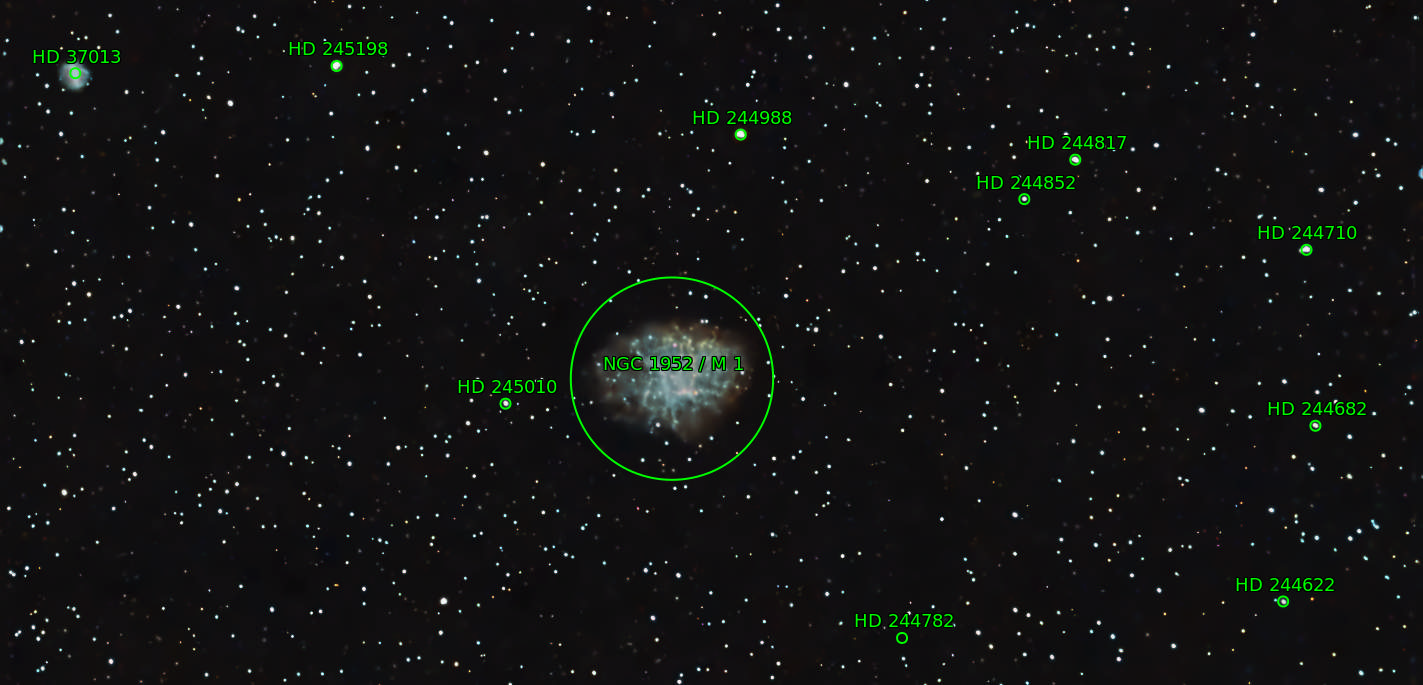
Annotations provided by Astrometry.net through an automated process of “plate solving”.
ZOOM – FULL SCREEN
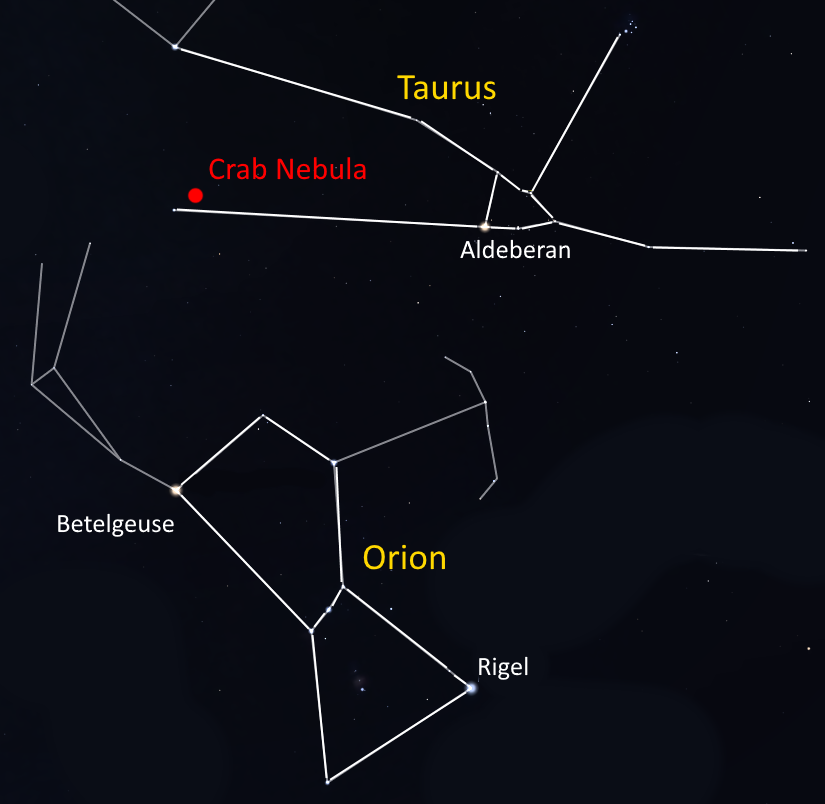
Surrounding Constellation – Taurus
Here’s a map showing where my photograph of M1 fits in the larger stellar field.